How to Stop Your Running Backpack Rubbing (Heavy Sweater Guide)
💧QUICK ANSWER
If your running backpack rubs, the problem is not always the pack itself.
For heavy sweaters, sweat softens the skin, increases friction and allows straps to move against your body. Even a well-fitting hydration vest can suddenly start rubbing after an hour or two.
I’ve had this happen several times during long runs and on ultra events. The worst was with my Rab Veil XP20 when the lower waist belt rubbed my lower back so badly that I finished with raw skin.
The biggest improvements for me came from:
✓Packing the bag correctly
✓Wearing the correct clothing to prevent rubbing.
✓Tightening it after the first 10–15 minutes
✓Applying anti-chafe cream before the run
✓Moving hard items away from pressure points
Most rubbing can be prevented before you leave the house.
Why Does a Running Backpack Rub?
Most runners assume backpack rubbing means the pack doesn’t fit.
Sometimes that’s true.
But heavy sweaters often experience something completely different.
As sweat builds up:
✅ Skin becomes softer
✅ Clothing becomes saturated
✅ Backpack straps move more easily
✅ Salt crystals increase friction
So where does rubbing happen most often?
Where Running Backpacks Rub Most
Lower Back
Lower back rubbing is one of the most common problems for heavy sweaters, especially during long runs or ultras when your clothing becomes saturated.
✅ Hard items pushing against the fabric
✅ Loose waist straps allowing movement
✅ Wet clothing increasing friction
Shoulders
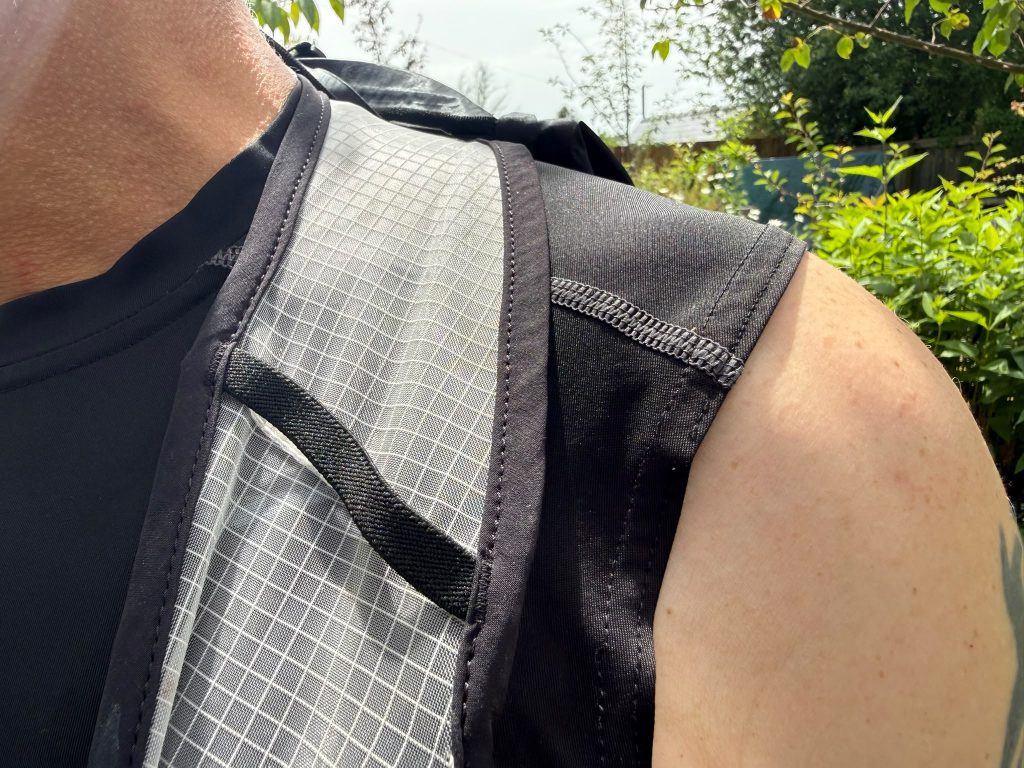
Shoulder rubbing usually develops gradually as sweat builds up and straps start moving against the skin.
✅ Backpack straps moving while running
✅ Excess bounce from a loose fit
✅ Salt build-up on clothing
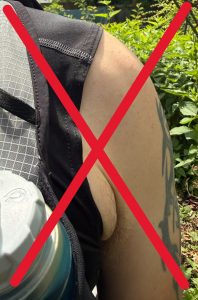
✅ Sleeveless tops exposing the shoulder to direct strap contact


Neck
A wet running top rubbing under the collar can quickly create an uncomfortable hot spot.
✅ Chest straps positioned too low
✅ Backpack riding too high
✅ Wet collars repeatedly rubbing against the skin

Under the Arms
Underarm rubbing is often caused by movement rather than the backpack itself and usually gets worse as you sweat more.
✅ Incorrect backpack sizing
✅ Overfilled front pockets pushing against the arm
✅ Constant arm movement creating friction

Waist Belts
Waist belts can be brilliant for stability, but they can also become a major source of rubbing for heavy sweaters.
As your running top becomes soaked, the belt traps a sweat-soaked running top against your skin and every stride creates a small amount of movement.
Over a long run, that constant friction can quickly turn into a painful hot spot.
✅ Don’t overtighten the waist belt
✅ Keep the belt sitting flat against your body
✅ Avoid trapping excess fabric underneath
✅ Re-adjust it once your pack has settled
For me, the sweet spot is snug rather than tight. Leaving just enough tension to stabilise the pack without compressing a soaked running top is much more comfortable over long distances.


My Experience
I’ve always been a heavy sweater.
On hot days my running top can be completely soaked within an hour and sweat often runs down my arms and legs.
During one long training run with the Rab Veil XP20, I packed several harder items low down in the backpack near the waist belt.
By the end of the run the lower belt had rubbed my back so badly that I finished with a raw patch of skin.
The problem wasn’t actually the backpack.
It was a combination of:
✅ Sweat
✅ Pressure
✅ Movement
✅ Poor packing
Changing how I packed the bag completely solved the issue.
My Packing Strategy
This made the biggest difference for me.
After experimenting on long runs and while training for the Camino, I realised backpack rubbing wasn’t caused by the pack—it was caused by how I packed it.
I now follow three simple rules:
✅ Heavy items high and close to my back
✅ Soft clothing between my back and anything hard
✅ Keep chargers, battery packs and other hard objects away from my lower back
This is the layout I now use on every long run:

I haven’t had a lower back rubbing problem since changing to this packing layout.
Choose the Right Clothing
The right running top can make a huge difference.
Loose clothing traps sweat, moves against your skin and allows backpack straps to rub far more than they should.
Wear Close Fitting Tops
✅ Loose tops bunch underneath shoulder straps
✅ Wet fabric moves independently and creates friction
✅ Close-fitting technical tops stay in place and reduce rubbing
Avoid Sleeveless Tops
Sleeveless running tops leave your shoulders exposed, allowing backpack straps to rub directly against sweaty skin.
For long runs and ultras, I almost always choose a lightweight technical T-shirt instead.

Choose Technical Fabrics
✅ Cotton holds moisture and stays wet
✅ Technical fabrics dry faster
✅ Less movement means less rubbing
Use Anti-Chafe Protection
If I’m expecting a long or hot run, I apply anti-chafe balm before I leave the house.
I concentrate on:
✅ Lower back
✅ Shoulders
✅ Collar line
✅ Under arms
It’s much easier to prevent rubbing than try to fix it halfway through a run.
Adjust Your Pack After 10 Minutes
Many runners tighten their backpack once and never touch it again.
I almost always stop after 10–15 minutes.
By then:
✅ Water bottles have settled
✅ Clothing has warmed up
✅ The pack has found its natural position
A small adjustment often removes the movement that causes rubbing later.
Don't Ignore Hot Spots
If you feel rubbing starting, don’t try to run through it.
Stop and deal with it straight away.
✅ Reposition the pack
✅ Tighten the straps
✅ Apply lubricant if you have it
✅ Move any hard items
Five minutes spent fixing a problem is much better than running another 20 miles with raw skin.
Can Salt Build-Up Make Backpack Rubbing Worse?
If you’re a heavy salty sweater, I think the answer is yes.
After a couple of hours I often notice white salt marks on both my running top and backpack straps.
As the moisture evaporates, those salt crystals sit between the fabric and your skin.
Combined with constant movement, they can make rubbing feel much worse than it did at the start of the run.
I haven’t seen any research proving this, but from years of ultra running it’s something I’ve experienced repeatedly.
One simple tip is to wash both your running tops and hydration vest regularly to remove built-up salt.
My Current Strategy
After years of finishing runs covered in sweat, this is the routine that works for me.
✅ Pack soft clothing against my back
✅ Keep heavier items high and close to my body
✅ Apply anti-chafe balm before long runs
✅ Wear a fitted technical running top
✅ Re-adjust my backpack after the first mile
Since changing my packing strategy, backpack rubbing has become very rare—even during hot ultra training runs.
Common Mistakes
❌ Overfilling front pockets
❌ Putting hard items against your back
❌ Wearing a loose cotton top
❌ Never re-tightening the pack
❌ Ignoring a hot spot
Frequently Asked Questions
Why does my hydration vest suddenly start rubbing?
Usually because sweat has softened your skin and allowed the vest to move more than it did at the start of the run.
Small movements repeated thousands of times quickly become rubbing and eventually hot spots.
Does a tighter backpack stop rubbing?
Not always.
✅ Too loose allows movement
✅ Too tight creates pressure points
The goal is a secure fit that stays stable without restricting movement or breathing.
Does anti-chafe cream actually work?
For me, absolutely.
It won’t fix a badly fitting backpack, but it significantly reduces friction on long, sweaty runs and is one of the easiest ways to prevent rubbing before it starts.
Can sweat alone cause backpack rubbing?
Yes.
Heavy sweat softens the skin, saturates clothing and increases friction, making rubbing much more likely even with a high-quality running backpack.
That’s why heavy sweaters often experience rubbing when other runners don’t.
.
Should I buy a different backpack?
Maybe—but I would adjust your packing strategy first.
Many rubbing problems are caused by how the backpack is loaded rather than the backpack itself.
Changing where you place heavier and harder items can make a surprisingly big difference.