
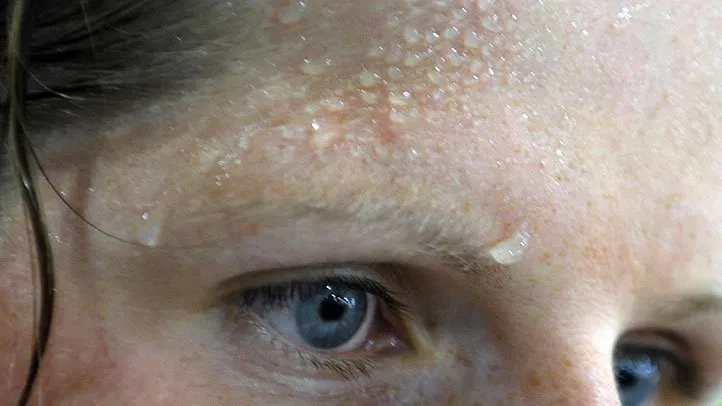
How to measure your sweat rate
Working out your sweat rate is a really helpful way to understand how much you need to drink during training and on race day.
It doesn’t have to be complicated – it’s simply about getting to know how your body responds when you’re active.
Everyone’s sweat rate is different. Things like your body size, fitness level, how hard you’re working, the weather, what you’re wearing and even how well you’re adapted to the heat can all change how quickly you sweat.
So if your numbers vary from day to day, that’s completely normal.
The best approach is to check your sweat rate a few times in different conditions.
Once you’ve got a handful of results, you can start to spot patterns and use them to guide your fluid and electrolyte plan for your next training block or race.
It’s all about learning what works for your body so you can feel confident and prepared out on the trail or road.
How to Calculate Your Sweat Rate
you will need some kit to do the test.
- A set of weighing scales to weigh you, so floor scales.
- A set of Food measuring scales Note only needed if you plan to eat or drink during the session
- A towel to dry off after the session
Step-by-step method
- Start by weighing yourself – this we will call your “W” number.
Make sure you go to the toilet first, then weigh yourself twice to get a consistent reading.
Do this with no clothes on so you don’t have to factor in sweat-soaked kit later.
If stripping off is not an option because you are in public, then you can weigh your clothes separately and subtract the difference.
- Do your training session and track what you eat and drink.
The easiest way is to drink from one or two bottles only.
Weigh your bottle(s) before the session (“A”) and again afterwards (“B”) so you know exactly how much you drank.
Because 1 gram = 1 ml, the difference gives you the fluid amount you consumed (“C”).
If you use other units like fluid ounces, just convert everything to litres or kilograms so the numbers line up.
- After your session, dry off and weigh yourself again – this we will call your “X.” number
Weigh yourself twice again, the same way you did at the start.
If you weighed yourself nude before, do the same now. If you were clothed, stick to that – consistency helps.
(Remember that clothes can hold sweat, so nude is always the most accurate.)
- Work out how much bodyweight you lost – this we will call your “Y.” number
Subtract your post-exercise weight (X) from your pre-exercise weight (W).
Weight lost (Y) = W – X
- Now work out how much fluid you consumed – this is your “C.” number
Using your bottle and food weights from earlier:
Weight of fluids consumed (C) = A – B
- Time to calculate your sweat rate.
Use this formula:
Sweat rate = (Y + C) × (exercise duration in minutes ÷ 60)
This gives you your sweat rate in litres per hour.
A quick note about toilet breaks
It’s best to avoid using the toilet mid-session if you can, as it throws the numbers off.
If you do need to go, the ideal approach is to weigh yourself before and after to measure urine output.
If that’s not practical, you can use a rough estimate:
assume about 0.3 L (300 ml) per bathroom visit, and subtract that from your final sweat rate.
I would suggest doing your sweat-rate tests during sessions that last between 60 minutes and 2 hours.
Shorter sessions can give misleading results because your body might not have reached a steady sweating rhythm yet – and the maths can get a bit skewed.
On the other hand, really long sessions can also throw things off. That’s because other factors start influencing your weight, like how much fuel you burn (using up glycogen slightly reduces body weight) and how much water you lose simply through breathing – especially if you’re working hard.
To make life easier, you can input all your numbers into a spread sheet so you have a record of your tests.
You can then add notes such as what type of workout you did, how long it lasted, the intensity, the temperature, and whether you were training indoors or outside.
It’s an easy way to keep your records in one place and for comparison.
You can also add your sodium loss numbers into the spreadsheet thereby providing you with your complete picture in one place.
For a guide on how to estimate your sodium loss CLICK HERE
Sweat Smart Running has created a handy product review on the top 5 Hydration products for a high sweat rate CLICK HERE to see